The Blue Verditer Copper Oxide Paint
A vivid fragment of 17th‑century Blue Verditer pigment, revealing early decorative ambition far beyond that of a simple farmhouse.

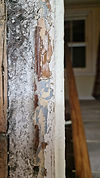
The first hint that Milton of Finavon held a deeper story came from a flash of colour on a boxed in lintel in the middle hall. Then beneath later layers of paint lay a vivid electric blue — unmistakably Blue Verditer, a pigment made from copper and prized in the 17th and early 18th centuries for its brilliance.
Even after more than three centuries, the colour remains startlingly bright. The binders have long since broken down, leaving the surface soft and chalky to the touch, but the pigment itself has held its ground. It is a rare survival, and one that immediately raised questions. Blue Verditer was not the sort of paint used in a working farmhouse. It was expensive, fashionable, and associated with houses of taste and means.
The fragment has now been protected behind a conservation panel, but its presence continues to speak loudly. It tells us that long before the later alterations, Milton carried a level of refinement that had been forgotten. This was a house built for someone who cared about colour, style, and the visual language of the early Georgian period.
In many ways, this small patch of blue was the first thread that, once pulled, began to unravel the old story of the house and reveal the truth beneath.